


As we reach the end of the year (where did it go?), what are the big issues impacting SMEs that are likely to carry over from 2025 into 2026?
The Changing Consumer Economy
The consumer economy that powered economic growth in the post-war period is stalling (1945 onwards for younger readers). Consumption-based growth depends on two things: a growing population and improving living standards. I.e., it requires more people becoming wealthier and buying more to create a virtuous circle of growing prosperity. An ageing population and declining living standards represent a massive challenge to the economic system on which all developed countries depend.
An ageing population is spending less and saving more, whilst wealth inequality has reduced the average consumer’s spending power. A recent Moody’s study in the US estimated that the wealthiest 10% of Americans accounted for over 50% of consumer spending in 2025, up from under 30% in the 1990s. It is likely to be a similar picture in the UK, and this is hugely important for businesses to understand.
We are seeing a hollowing out of the middle market.
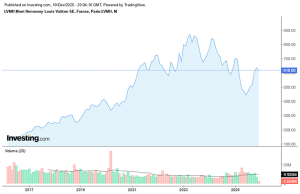
Retail sector growth over the past few years has been concentrated at opposite ends of the spectrum – high-end luxury brands and discount stores. There is a reason Barnard Arnault, founder of luxury brand group LVMH, is now worth £150bn.
Source: Investing.com
Aldi and Lidl are examples of growth at the discount end of the market. This is a direct result of these shifts in demographics and wealth distribution.
It’s not just online shopping that has hit the high street; we’ve seen the failure of many mid-market retailers as the size of the middle market has shrunk – think Debenhams, Toys ‘ R ‘ Us, Mothercare and the like. Shopping centres such as St David’s in Cardiff have been successful in changing consumer trends by moving upmarket and attracting the premium brands. In contrast, traditional town and city centres are now mostly occupied by the discounters.
The hospitality industry has also been impacted – Wetherspoons is still doing brisk trade at the discount end of the market, and those pubs that have successfully transitioned to higher quality dining are doing ok, but all those pubs in between are finding it tough.
The car market is another example. For the last few years, many brands have focused on the growing high-end of the market, with top-of-the-range cars now costing eye-watering amounts – Range Rovers now cost up to £300k. Easy financing has propped up the middle market for a few years, but all the growth is now in the value for money brands – Dacia, MG and the new Chinese entrants.
This fundamental consumer shift away from the middle has consequences for businesses. Smaller businesses, especially, will have to work harder and smarter to retain and win customers. It’s important that businesses understand what their customers value and are paying for by having a clear brand proposition, understanding the mix between price, product quality, branding, customer service and how your target market is potentially changing. Moving your brand up or down the value chain is notoriously difficult, breaking up into the premium or luxury market is expensive and risky, but likewise moving down the value chain can undermine brand value and turn existing loyal customers off. Marks and Spencer are continually tormented by this existential conundrum – attempts to reduce quality and prices to attract new customers is always met with backlash from loyal customers – I still bemoan the diminished quality of their socks – while their move into premium branding with Autograph has taken 20 expensive years of hits and misses to try and establish itself with consumers.
Beyond these short-term target market considerations for businesses, there are genuine questions about what the entire future of the consumer economy looks like, but that is for another column.
Big Business and Private Equity are the Winners, and Small business the losers
The broader economic story of the past few years, which I see continuing, is the growth and dominance of large enterprises and private equity at the expense of small businesses. Complex taxation and regulation continue to have a disproportionate impact on the profitability and even viability of small businesses. The frustration is that it’s not because big business is better run or more productive; the disproportionate growth of big business can almost entirely be put down to the widening gap in relative financing costs and effective tax rates. With much of the remaining gap down to regulatory arbitrage.
Examples include Uber: use cheap financing to undercut local small-business competition until you are the dominant firm; arbitrage employment legislation; once everyone is captive on your app, jack up prices. Uber has to continually expand margins to increase its market value, extracting value that previously stayed in the local economy, while also minimising its tax liability through global holding companies.
Other examples are those which load monopoly businesses with debt and maximise profit extraction, usually at the expense of employees and customers (Thames Water, Manchester United etc). More recently, we’ve seen private equity hoover up local businesses (vets, fire safety, pharmacies, opticians, builders’ merchants, tech support, retailers). The model is to consolidate, grow margins (raise prices and cut costs), and then sell the businesses at a profit. While there are some reputable, well-run private equity-backed businesses, the model is driven by short-term profitability and value extraction, and often involves squeezing out local small-business competition to secure monopoly pricing power (see the CMA investigation into Vet pricing).
Amazon, which a few years ago provided a platform for people to be enterprising and set up their own small businesses, is now shifting its business model to proprietary selling at the expense of squeezing the smaller operators.
With Donald Trump in the White House, we are entering a period of peak power and influence for big business, which means the profit grab and preferential treatment are likely to continue for a few years. Small businesses just have to hunker down for now and focus on the things that drive long-term success – looking after your staff and your customers.
The first potential breach of this wall occurred in Australia, where social media has been banned for under-16s. Maybe in a decade or two, we will look back on the era of unregulated and unrestrained big business and wonder what we were doing, in the same way we now view past attitudes to smoking and lead in petrol. The Bank of England is beginning to warn of a potential bubble in shadow banking and we have seen a couple of major private equity failures. In the long term, this should end up being good for small businesses, but there will be short-term pain.
The AI Revolution
Undoubtedly, the big story of 2025 and 2026 is AI. The battle currently playing out is one of evolution versus revolution. There are vocal cheerleaders on both sides. While General AI (Chat GPT and the likes) is impressive, it has not yet proven to have a profitable business model. The revolutionists believe AI will replace many jobs and completely alter society; the evolutionists believe it will improve Google search results a bit. The truth is always in the middle. AI will transform some areas of the economy and jobs, such as research and development, healthcare and product design, but for the majority, it will just incrementally make us more productive in the same way spreadsheets and email did in the 90s, the internet did in the 00s, and smartphones, cloud software and video calls have more recently.
The internet, smartphones and computing power have made data a much more valuable commodity; similarly, AI will make knowledge a far more valuable commodity, after all, computers ultimately need human knowledge from which to learn. Far from replacing workplace knowledge and experience, I think it will make them even more important. While AI frees us from low-value-add tasks, someone will still need the knowledge to understand the nuances and blind spots that AI will find difficult to navigate. AI will remain somewhere between that annoying bloke you get stuck talking to who thinks he knows everything but understands nothing and that one friend who smugly answers all the questions at the pub quiz first even when you knew the answer too.
We are still waiting to see the real successes and failures of the early adopters. For many small businesses, the impact will be gradual, and it’s a case of trying to keep as up to date as possible, but like the internet, it may transform some tasks more radically overnight.
The biggest short-term risk AI represents to business is the US stock market. US household wealth is more dependent on the stock market now that at any time in history so any bursting of a bubble could trigger a bigger recession. I’ll throw crypto into the mix here. Microsoft, Google, Meta, and Nvidia all have profitable underlying businesses, so they will survive any bursting of the bubble. Crypto, with no underlying value, is an unknown quantity, and there is little data as to how interdependent the wider economy has become.
Entry Level Recruitment
Almost every conversation I have with business leaders and owners quickly turns to recruitment. Regardless of political persuasion, the NI increase was a poor way to increase tax revenue and has had a significant impact on entry-level recruitment, but it is just one part of the story. It feels like there is a perfect storm brewing in recruitment. Traditional educational qualifications have diminished in value for employers – school, college and university leavers’ qualifications offer little more than a rough guide to aptitude and skills relevant in the workplace. Many businesses report anecdotal evidence of an attitude problem: people not showing up for interviews, and people showing up for work on day 1 and never being seen again. The numbers don’t lie, with 1 million 17-24 year olds not in education or employment in the UK, and 1 in 4 children suffering with their mental health. The pathway from education to employment is broken. Almost every education reform of the past 30 years looks to have taken us backwards. Employers are going to have to take the lead in trying to solve some of the issues. Every larger employer should be talking to their local school, college and university. Solving this is my priority issue in relation to my work with Chambers Wales; we need to work with the government to reform education to meet the needs of employers and employees. No child should leave education without a clear career path. The solutions are complex, in my own experience one of the issues is that school is just not fun anymore and children are anxious and being put off from education at a very early age. Next is the issue that current qualifications do not contribute enough to future career pathways. In my day, talented and smart people could take 3 years off at university doing an English degree while they drink and decide what they want to do. That no longer makes sense when it comes loaded with debt, and everyone else has done the same. It is a classic example of policy not seeing the wood for the trees. Increasing the Minimum wage for young people above the rate of inflation is not going to help. Back in the day we all started our careers with Saturday jobs or working behind a bar. That first job is important in teaching the responsibility of having a job, regardless of what career you go on to, and the government should be doing the exact opposite by encouraging businesses to create more “first job” opportunities. Supermarkets used to be the main source of part-time jobs for teenagers, but look around Tesco and you’ll see most of those jobs are now going to over-50s. Apprenticeships require further reform to better serve small businesses. Businesses know how to train their employees and equip them with the necessary skills, so we need Apprenticeships to be more flexible in the mix of on-the-job training and offsite education.
In the short term, all this means an increasingly competitive market for talent, skills and experience. Businesses must compete to be the “employer of choice” and invest more in retaining and recruiting staff. The intrinsic value to any business of good talent is increasing.
I’m not one for bemoaning the youth of today, though; this is very much an “and us” problem, not a them” problem.
Good Businesses Succeed
My final thought is always that, whatever the economy, issues and circumstances, good, well-run businesses can succeed and grow. You need the right people doing the right things at the right time. Getting resource allocation and prioritisation right is the fundamental challenge of running any organisation, as is learning from experience and being prepared to change your mind when necessary. The best annual business plan I’ve seen just said “we’re going to do the same as we did last year, but we’re going to do it a little bit better”. That is my plan for 2026.